
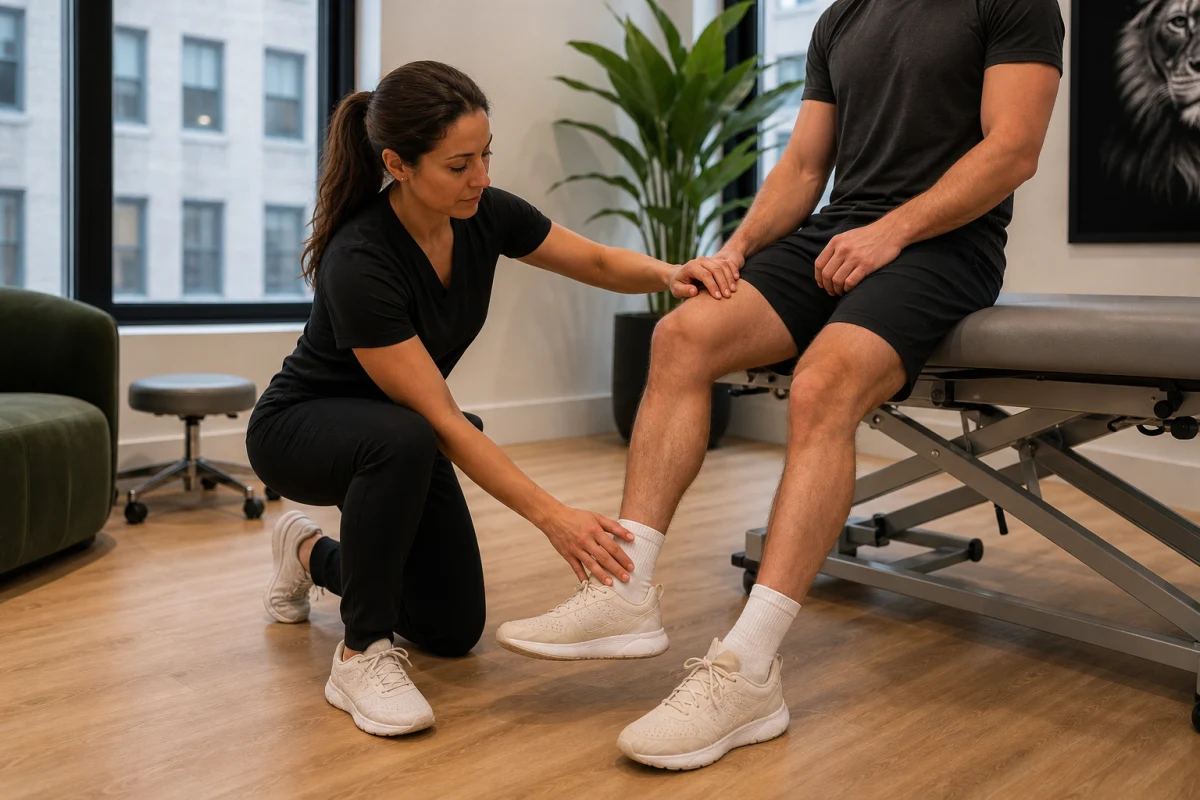
When injured tissues are not properly rehabilitated or treated, the body begins to compensate in order to continue functioning. While this compensation may temporarily reduce pain or let you keep up with daily activity, it often creates abnormal movement patterns that place excessive stress on surrounding muscles, tendons, ligaments, joints, and nerves over time.
What happens when an injury doesn't fully heal?
Take a common ankle sprain as an example. Many people roll their ankle, rest for a few days, and return to activity once the swelling and pain improve. However, even after symptoms calm down, the ligaments around the ankle may still be weakened, the small stabilizing muscles around the foot and lower leg may not be firing properly, and balance or proprioception, your body's awareness of positioning and movement, may still be impaired.
As a result, the body begins shifting weight differently in order to protect the injured side. Over time, this can change the way you walk, run, squat, train, or even stand.
How an old ankle injury becomes knee, hip, or back pain
What starts as a simple ankle injury can eventually contribute to:
- Tight calves and Achilles irritation
- Knee pain from altered loading patterns
- Hip tightness and instability
- SI joint or low back pain
- Decreased athletic performance
- Reduced mobility and balance
- Recurrent ankle sprains due to chronic instability
This is why a symptom in one area often traces back to an unresolved problem somewhere else. Related reading and care at Sinar:
- Sports rehab & return to activity care
- Running injuries and the kinetic chain
- Active Release Technique for soft tissue restriction
Why your hamstrings might be the symptom, not the cause
One of the most overlooked consequences is hamstring dysfunction and injury. The hamstrings play a major role in stabilizing the pelvis and controlling lower body movement during walking, sprinting, jumping, and athletic activity. When the ankle loses stability or mobility, force is no longer absorbed efficiently through the foot and lower leg. The body then shifts more stress into the posterior chain, especially the calves, glutes, and hamstrings.
Over time, the hamstrings begin compensating for the lack of stability below them. This can lead to:
- Chronic hamstring tightness
- Recurrent strains or “pulls”
- Muscle fatigue during training
- Reduced explosiveness and sprint performance
- Increased tension through the hips and low back
In many cases, the hamstring itself is not actually the root problem. The true issue may be the altered movement mechanics created by the unresolved ankle injury months, or even years, earlier.
This happens because the body functions as one connected kinetic chain. When one joint loses stability, mobility, or proper mechanics, surrounding areas are forced to compensate. Muscles that were never designed to absorb that amount of stress begin overworking, while others weaken from underuse.
Injured tissues themselves can also change over time when not properly treated. Scar tissue may form in a disorganized way, circulation to the area may remain poor, inflammation can linger at a low level, and surrounding muscles often become guarded and tight. Eventually, the body normalizes dysfunction as its “new normal.”
What proper rehabilitation actually involves
Proper rehabilitation is not just about reducing pain, it is about restoring tissue quality, rebuilding strength and stability, improving circulation, retraining movement patterns, and optimizing overall function so the body can move efficiently again.
How Sinar Treatments addresses the root cause
At Sinar Treatments in Midtown Manhattan, our approach focuses on identifying the root cause of dysfunction rather than simply masking symptoms. Through personalized chiropractic, athletic training, mobility, and conditioning treatments, our goal is to help patients recover fully, prevent future injury, and continue performing at their highest level.