
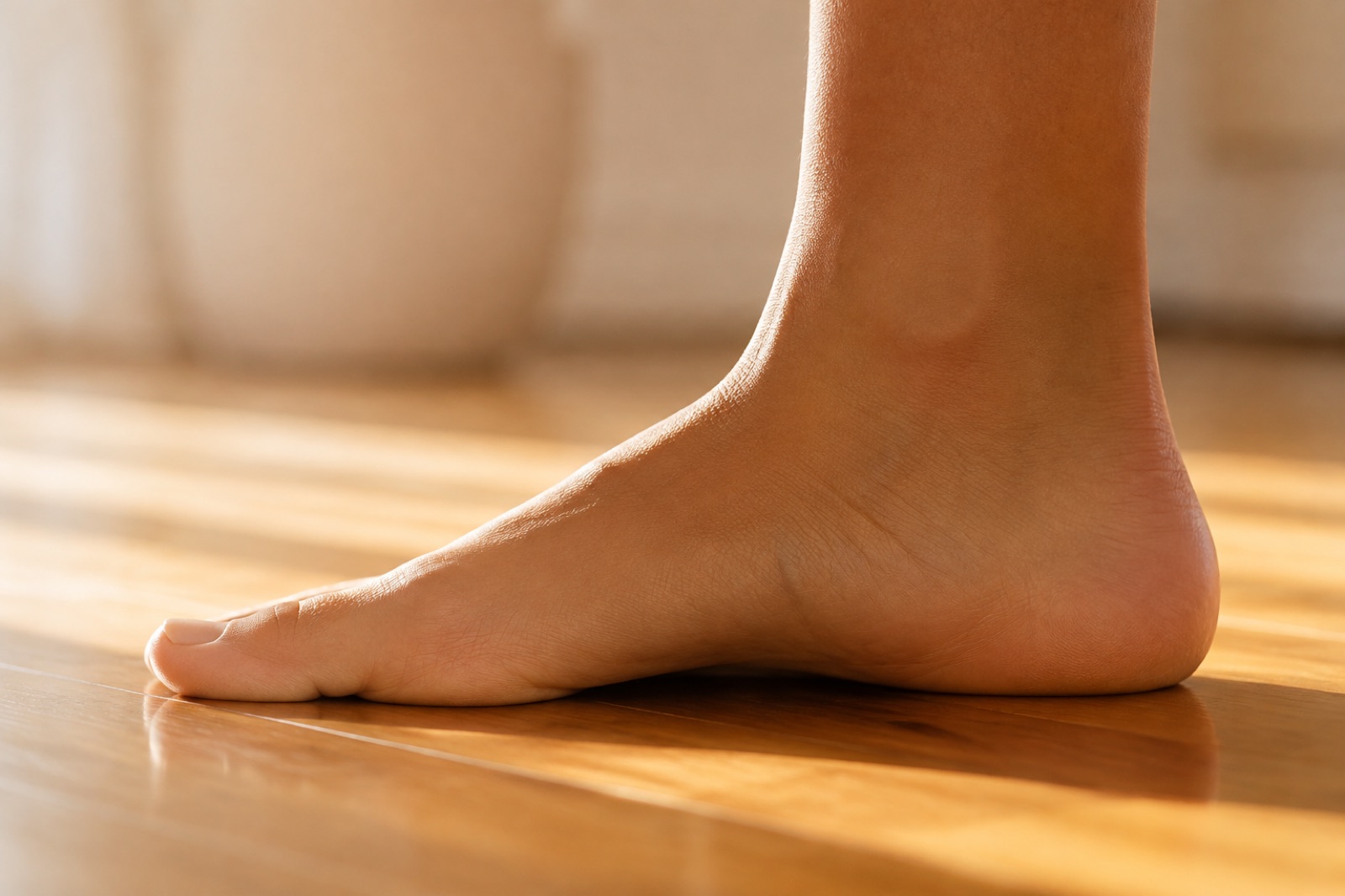
Plantar fasciitis is one of the most common foot injuries in New York City, where daily walking on concrete never gives the tissue a true rest. Here is what actually drives it and how hands-on care addresses it.
The first step out of bed is the one that gives it away. A sharp, stabbing pain in the heel or arch, worst in the morning or after sitting for an hour, then gradually dulling as you start moving. For many people in Midtown Manhattan and across New York City, this pattern becomes so familiar it barely registers as a problem worth addressing. It gets written off as tired feet from the commute, or shoes that need replacing. Most of the time, it is plantar fasciitis. And it does not resolve on its own without addressing what is actually driving it.
What Plantar Fasciitis Actually Is
The plantar fascia is a thick band of connective tissue that runs along the bottom of your foot, from the heel bone to the base of your toes. It acts as a spring and a shock absorber with every step. When it is repeatedly loaded beyond its capacity to recover, small tears accumulate in the tissue, most often at the attachment point on the heel. The result is localized inflammation, stiffness, and the characteristic pain that tends to be sharpest after rest.
The condition has a reputation for being stubborn, and that reputation is earned. Most cases do not involve a single moment of injury. They build gradually from months of repetitive loading without adequate recovery between bouts of stress. The tissue is not getting a true rest. For someone walking three to five miles a day on Midtown sidewalks, riding the subway in rigid-soled shoes, then sitting for eight hours with shortened calves, there is no point in the day where the plantar fascia is fully unloaded and left to recover.
The reason it recurs so often is that most people treat the symptom, not the pattern that created it.
Why New York City Is Hard on Feet
NYC is not a forgiving surface. Concrete and asphalt have almost no give. Unlike running on grass or a track, every step on Midtown pavement transfers a high percentage of load directly into your heel and arch. Add to that:
- Long walk distances between subway stations and offices near Bryant Park, Grand Central, and Herald Square
- Standing on platform surfaces in dress shoes or fashion footwear with minimal arch support
- The shortened calf and Achilles complex that develops after hours of sitting at a desk
- Heel-heavy gait patterns that many people develop when rushing through crowds
Runners training along the East River or through Central Park face the same issue compounded by weekly mileage. Desk workers in Midtown deal with a version that develops more slowly but can be just as disabling when it reaches a chronic stage, because the tissue has been adapting around load for months before it becomes noticeably painful.
What Usually Does Not Work, and Why
Rest alone rarely resolves plantar fasciitis once it has become a recurring problem. Taking a few days off reduces acute pain, but the tissue restrictions and movement patterns that created the overload remain unchanged. You step back into the same shoes on the same streets and the cycle restarts.
Generic calf stretching is useful in early-stage cases, because the gastrocnemius and soleus attach at the heel and tight calves do increase load on the plantar fascia. But if the tissue itself has developed dense restrictions, adhesions, or altered texture from months of micro-trauma, stretching alone will not change its quality. You are working around the problem, not through it.
Cortisone injections reduce inflammation in the short term but do nothing to address the tissue quality or movement patterns that drove the inflammation. Many patients find themselves back in pain within a few months. Night splints can be part of a plan but are not a standalone solution. They prevent the fascia from contracting overnight, which reduces morning pain, but do not treat the tissue itself.
The missing piece in most conservative approaches is hands-on work that directly addresses the quality of the tissue and the mechanical chain loading it.
What Active Release Technique and IASTM Actually Do for Plantar Fasciitis
Active Release Technique (ART) is a hands-on soft tissue method that uses precise provider contact combined with patient movement to address restrictions in muscles, tendons, ligaments, fascia, and nerves. For plantar fasciitis, this means working directly through the arch and heel to identify where the tissue has lost normal texture or motion, then systematically restoring it.
ART is particularly effective for this condition because the plantar fascia does not exist in isolation. It is continuous with the calf, the Achilles, and the soft tissue of the lower leg. Adhesions anywhere along that chain alter how load is distributed across the foot. A certified ART provider finds exactly where those restrictions are and addresses them specifically, rather than applying a general protocol to the whole area.
Instrument-Assisted Soft Tissue Mobilization (IASTM), including Graston-style techniques, uses stainless steel instruments to detect and treat areas of fibrosis and altered tissue density. For chronic plantar fasciitis in particular, where the tissue has been symptomatic long enough to develop scar tissue patterns, IASTM can reach and affect areas that manual pressure alone cannot address as precisely. Kinesio taping applied after treatment can reduce load on the fascia during the recovery period and provide arch support as the tissue heals between sessions.
These approaches are not interchangeable with general massage. The work is tissue-specific, site-specific, and calibrated to what the assessment shows.
The Lower-Chain Picture: It Is Rarely Just the Foot
One of the most consistent oversights in plantar fasciitis care is treating only the foot. The mechanical chain that loads the plantar fascia runs from the hip to the heel. When that chain is functioning well, load is distributed across multiple joints and tissues. When it is not, the foot absorbs disproportionate stress with every step.
Hip extension restrictions, for example, cause the lower leg to compensate by pronating more aggressively during stance. That increased pronation directly increases tension through the medial plantar fascia. Tight or inhibited glutes shift load forward onto the forefoot and arch. Ankle mobility deficits, common in people who spend most of the day seated, alter how the heel loads during push-off. None of these show up as foot pain directly, but all of them feed into it.
A complete approach to plantar fasciitis evaluates how your hip, knee, and ankle are functioning, not only the site of pain. Treating the site without addressing what is loading it tends to produce temporary results.
How Sinar Treatments Approaches Plantar Fasciitis
At Sinar Treatments, Dr. Ashley Narain, DC, ART approaches plantar fasciitis through a combination of soft tissue and movement assessment, with treatment calibrated to what the tissue and the lower chain actually show.
The initial evaluation looks at the tissue quality of the plantar fascia, calf, and Achilles complex, then traces any contributing restrictions upward through the ankle, knee, and hip. Treatment typically combines Active Release Technique to address specific adhesions in the fascia and connected soft tissue, IASTM for areas of chronic fibrosis where instrument work is more precise, chiropractic joint assessment of the foot and ankle mechanics, and rehabilitation guidance for load management during recovery.
For runners, weekly training volume is part of the conversation. For Midtown office workers and commuters, footwear choices and daily walking patterns factor into the plan. Clinical nutrition is available for patients where systemic inflammation appears to be slowing tissue recovery. The approach is not a fixed protocol. It follows what the assessment reveals.
Sinar Treatments is at 389 Fifth Avenue, Suite 302, in Midtown Manhattan, accessible from multiple subway lines near Bryant Park, Grand Central, and Herald Square. You can reach the office at (212) 417-0199.