
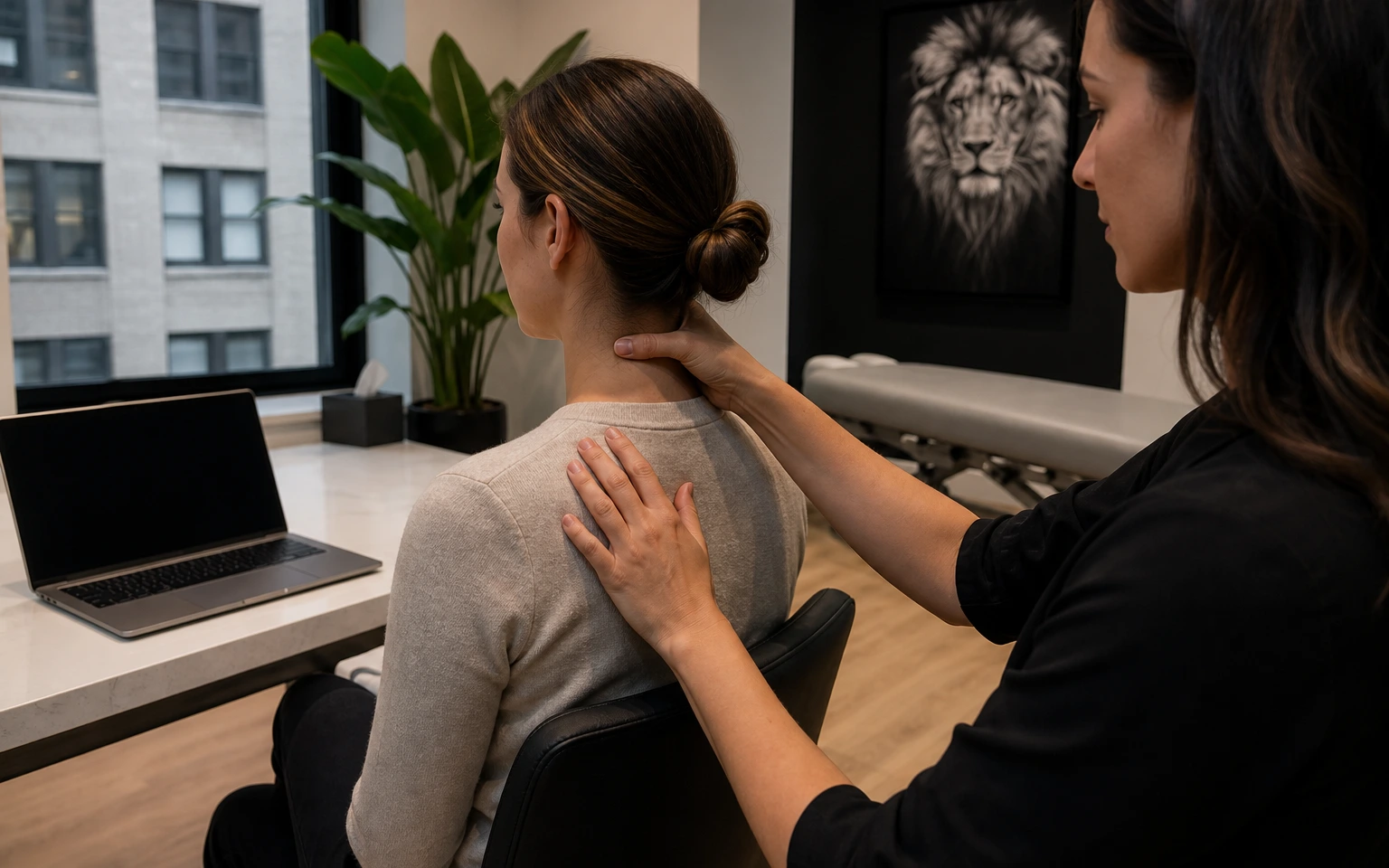
How forward head posture from phone and device use loads the cervical spine, and what SINAR does about it.
What the load actually looks like
Every inch the head moves forward of the shoulders adds roughly ten pounds of effective compressive force to the cervical spine. For most people looking at a phone or a monitor for several hours a day, that forward shift is two to four inches, which means a twelve-pound head can generate thirty to forty pounds of load at the base of the neck. Multiply that across hundreds of sustained static muscle holds over a full workday and the picture becomes clear: tech neck is a repetitive loading injury, not a single event.
Midtown Manhattan concentrates this problem. Office workers at Fifth Avenue and the surrounding blocks typically spend six to nine hours in a seated screen position, then add another 45 to 90 minutes looking down at their phones on the subway commute. By the time a patient presents at SINAR Treatments, the cervical pattern has usually been building for months, sometimes years.
Symptoms that share the same origin
Forward head posture does not always show up as neck pain. The same loading pattern produces a range of symptoms that often get treated as separate conditions:
- Headaches that start at the base of the skull and radiate toward the forehead or temples
- Chronic tightness in the upper trapezius and levator scapulae that resists foam rolling and stretching
- A dull ache in the upper thoracic spine between the shoulder blades
- Jaw tension or TMJ irritation from the way the hyoid and suboccipital muscles shift with the head position
- Shoulder impingement symptoms that trace back to how a forward head position alters the loading angle at the rotator cuff
- Numbness, tingling, or a pins-and-needles sensation into the hands that mirrors a cervical nerve root or brachial plexus distribution
Most patients who arrive at SINAR have already treated one of these symptoms, the headache, the shoulder, the hand, without connecting it to the cervical pattern driving it. Identifying that connection is where a thorough evaluation starts.
How SINAR evaluates the pattern
The assessment examines cervical joint mobility segment by segment, upper thoracic joint motion, and the quality and restriction of the soft tissue responsible for holding the head in position. Muscles like the suboccipitals, scalenes, levator scapulae, and deep cervical flexors all carry different roles in the forward-head pattern, and the examination identifies which are short and overloaded versus which are long and inhibited.
Scapular mechanics are part of the same picture. The shoulder blade's position and movement depend on the same thoracic and cervical structures that tech neck loads. Evaluating how the scapula moves during overhead and reaching motions tells the clinician how far down the kinetic chain the cervical pattern has traveled.
Posture assessment in this context is not asking someone to stand up straight. It is a structured look at which joints are restricted, which soft tissues are adhered, and how the patient's body is actually loading during their daily tasks.
How SINAR thinks about it
Care for tech neck at SINAR is not a single modality. Cervical joint restriction responds to chiropractic adjustment or mobilization, applied with specificity to the segment that is restricted. Upper trapezius, levator scapulae, suboccipital, and scalene tissue, which is often thickened and adhered from sustained loading, responds well to Active Release Technique. The thoracic spine, which tends to lock into flexion under chronic forward-head load, benefits from both joint work and targeted mobility drills that can be continued at home.
When nerve irritation is part of the picture, brachial plexus tension, cervical radiculopathy, or thoracic outlet symptoms, care is adjusted accordingly. The same tools apply, but with attention to the path the nerve follows through the tissue and which positions or movements are provocative.
IASTM and kinesio taping are used when they fit the tissue state. Taping is not decorative. A cervical proprioceptive facilitation tape changes the sensory input to the muscles that hold head position throughout the workday, which can extend the benefit of the in-clinic session into the hours the patient spends at their desk.
What changes outside the office
The most durable results come from changing what happens during the other twenty-three hours. SINAR's approach includes specific workstation adjustments, monitor height, keyboard and mouse position, seated hip angle, and the common ergonomic constraints that Midtown open-plan offices create. For commuters, even a small change in how the phone is held on the subway alters the cervical loading angle significantly.
These are not generic handouts. They are delivered in the context of what the assessment found for that specific patient, their tissue restrictions, their joint patterns, and their actual daily environment.
What patients leave with
- A clear explanation of what is being loaded and why the symptom pattern makes sense.
- A focused treatment plan built around that patient's cervical and thoracic findings.
- Practical workstation and commute adjustments that reduce re-loading between sessions.
- A booking path for follow-up care when the pattern requires more than a single visit to fully resolve.