
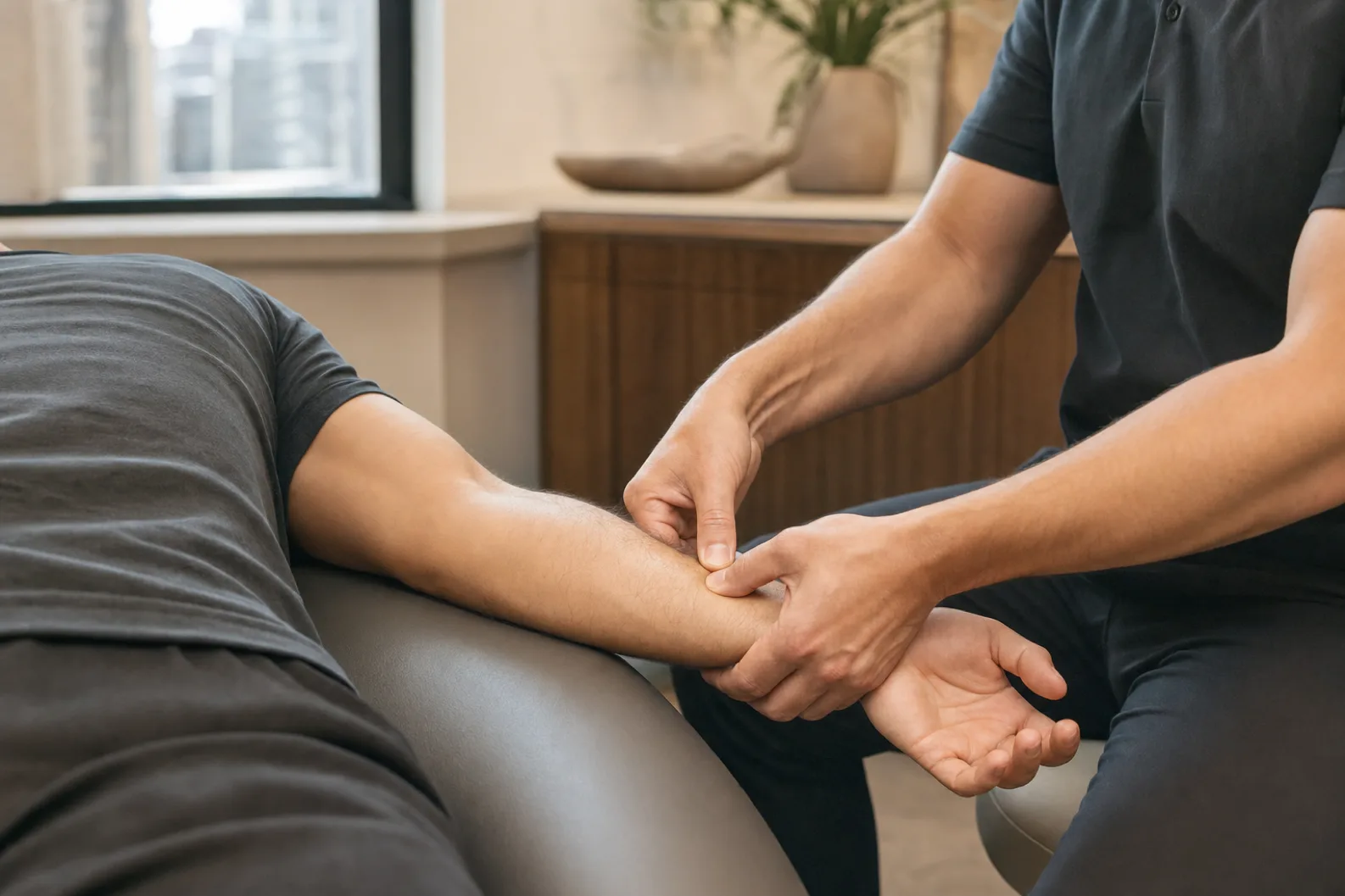
A patient arrives with a familiar story. The hand falls asleep at night. Typing brings on an ache through the forearm. Holding a phone on a long call makes the fingers feel thick and clumsy. Somewhere along the way, from a colleague, a search result, or a brief physician visit, the phrase carpal tunnel entered the conversation, and a wrist brace was purchased. It helps a little. The symptoms persist.
The carpal tunnel is a real structure and carpal tunnel syndrome is a real diagnosis. But it is also a frequently over-applied label, because it describes only the final inch of a nerve that travels the entire length of the arm. Treating the last inch of a nerve that may be restricted somewhere else is one reason a wrist brace alone often underdelivers.
The median nerve does not begin at the wrist
The median nerve originates from nerve roots in the lower cervical spine. It passes through the brachial plexus beneath the collarbone and the pectoralis minor, travels down the arm, crosses the elbow, threads between the two heads of the pronator teres in the forearm, and only then enters the carpal tunnel at the base of the palm.
That is a long path with several places where the nerve can be compressed or where it can lose its ability to glide freely through the surrounding tissue. A nerve is not a static wire. It slides and stretches as the arm moves, and it depends on healthy, mobile tissue around it. When the forearm flexors are dense and short from years of typing, or the pectoralis minor is tight from a rounded desk posture, or the lower neck is stiff and irritated, the nerve can produce hand symptoms without a single problem existing at the wrist.
How Midtown desks can aggravate this pattern
The environment in Manhattan office work is unusually consistent, and the mechanics it enforces are what load the median nerve:
- Sustained keyboard and trackpad use with the wrists held in extension and the forearms static for hours
- Phone and tablet use that adds a gripping, pinching demand on top of the typing load
- Rounded shoulder posture at a monitor, which shortens the pectoralis minor and narrows the space the nerve passes beneath
- Commutes spent gripping a subway pole or a bag handle, adding forearm load rather than relieving it
- Very few interruptions to the position across an eight to ten hour day
No single one of these is harmful. Held together, daily, for years, they can contribute to a denser forearm, a more closed shoulder girdle, and a nerve with progressively less room and glide. High keyboard use has not been shown to cause carpal tunnel syndrome, so persistent or atypical symptoms deserve evaluation rather than being attributed to desk work alone.
What the location of the symptoms tells us
The distribution of symptoms is diagnostic information, and it is worth paying attention to before accepting a label:
- The median nerve serves the thumb, index, middle, and half of the ring finger, and classic carpal tunnel symptoms tend to follow that distribution, though they can also radiate up the forearm.
- Numbness in the small finger suggests the ulnar nerve, not the median nerve, and points toward the elbow or the wrist's ulnar side.
- Symptoms spreading up the forearm or involving the whole hand can point to a source above the wrist, though carpal tunnel syndrome can radiate as well, which is one reason testing matters.
- Neck or shoulder symptoms accompanying hand numbness raise the possibility of a cervical contribution.
- Night symptoms relieved by shaking the hand are a classic median nerve presentation, but they still do not establish where the nerve is being restricted.
How Sinar evaluates wrist and hand symptoms
Dr. Ashley examines the entire path of the nerve rather than the site of the complaint. That means assessing cervical spine mobility, the space beneath the collarbone and pectoralis minor, elbow and forearm tissue quality, wrist mechanics, and how the nerve tolerates being moved and loaded.
Care is then directed at what the examination actually found, and typically includes:
- Active Release Technique and IASTM through the forearm flexors, pronator teres, and the tissue surrounding the nerve where it is restricted
- Chiropractic adjustments to the cervical spine and upper thoracic region when they are contributing mechanical load
- Nerve mobilization to restore the median nerve's ability to glide along its path
- Shoulder and scapular work to reopen the space the nerve travels through
- Specific changes to workstation setup and typing mechanics, so the tissue is not rebuilt into the same restriction between visits
When a surgical opinion is the right answer
Conservative care is appropriate for a large share of wrist and hand symptoms, and it is worth being direct about where it is not. Constant rather than intermittent numbness, measurable weakness in the hand, difficulty with grip that is worsening, or visible wasting of the muscle at the base of the thumb all warrant nerve conduction testing and a surgical consultation. Symptoms that follow significant trauma deserve prompt evaluation as well.
Sinar's role in those cases is to identify the pattern early and refer appropriately, rather than to continue conservative care past the point where it serves the patient.