
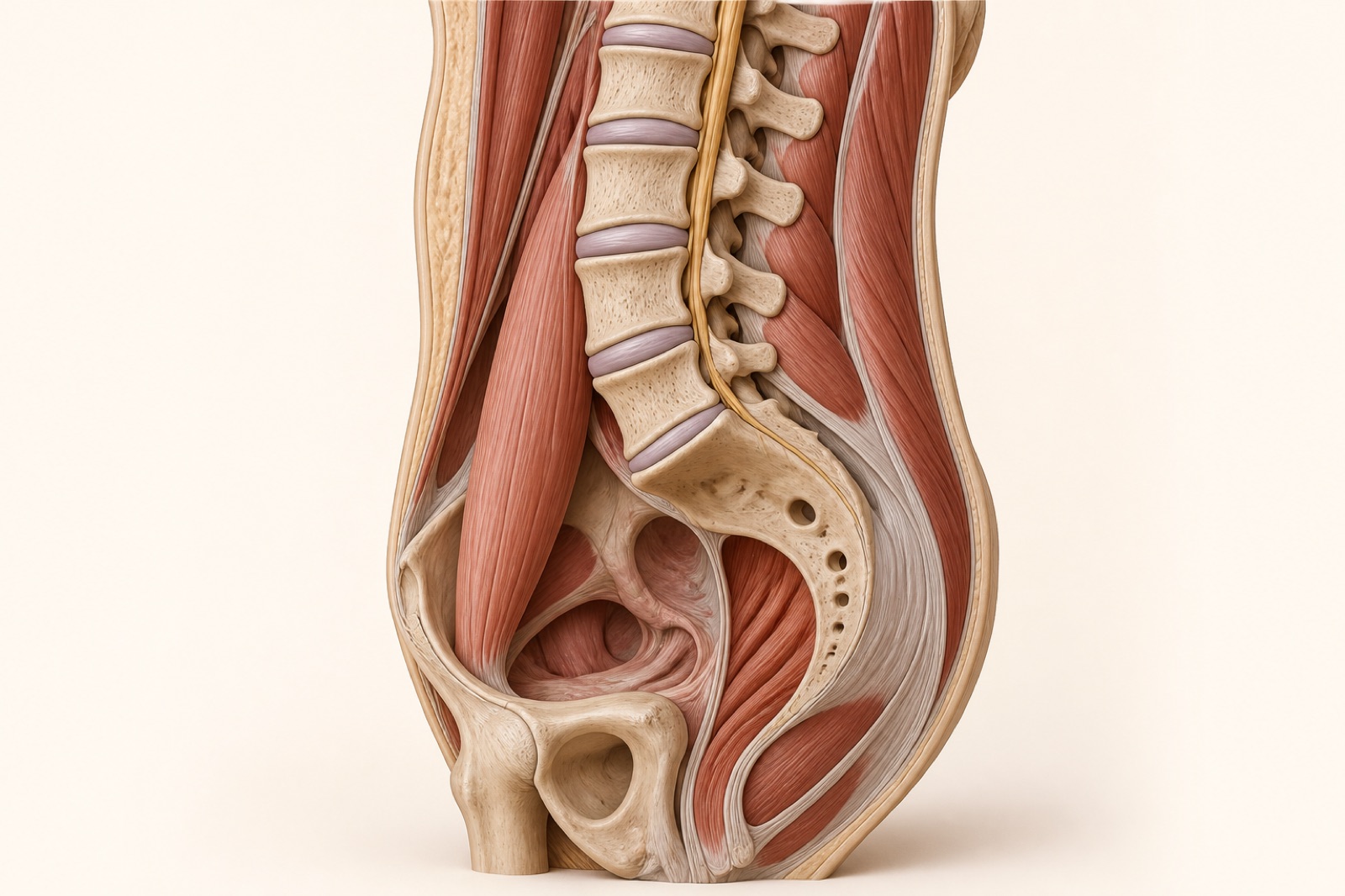
Low back tightness, anterior hip ache, and unexplained knee tension are often the same problem at different addresses, a hip flexor that never fully releases after eight hours of sitting.
Why sitting shortens the hip flexor
The psoas major and iliacus, collectively called the iliopsoas, run from the lumbar vertebrae and the inner surface of the pelvis to the top of the femur. When you sit, both muscles spend hours in a shortened position. That by itself is not an injury. The problem is that modern desk work compounds the issue: most people sit with their weight shifted back into the lumbar spine, their pelvis tilted posteriorly, and their hip flexors held at reduced length for six to nine hours before they stand up to walk home.
Over time that repeated shortening creates tissue adaptation. Fascial layers thicken, muscle spindle sensitivity shifts, and the psoas in particular can develop dense adhesions at the muscle-tendon junction, an area that passive stretching barely touches. The result is not dramatic enough to call an injury, which is part of why it persists unaddressed for so long.
How hip flexor restriction shows up as something else
A shortened iliopsoas does not produce pain right where it lives. It produces compensation patterns, and those patterns produce symptoms at seemingly unrelated locations:
- Low back pain. A tight psoas pulls the lumbar spine into anterior tilt, increasing compression at the L3 to L5 facet joints. Prolonged anterior tilt is one of the most common mechanical contributors to persistent low back pain in people who otherwise have no structural pathology on imaging.
- Anterior hip ache. The hip flexor attaches just below the lesser trochanter. When it is chronically shortened, the attachment point becomes irritated, especially during activities like stair climbing, getting up from a chair, or the first few steps after sitting for a long time.
- Quad tightness and knee tension. The rectus femoris, one of the quadriceps, also crosses the hip. When the hip flexor group is restricted, the rectus often compensates. Runners in this pattern develop anterior knee pain; desk workers more often feel a vague heaviness in the quads and stiffness through the kneecap.
- Glute inhibition. An overactive hip flexor suppresses the gluteus maximus through reciprocal inhibition. This is why people with hip flexor tightness often also report that their glutes feel weak or are slow to fire during exercise, the flexor is neurologically competing with the extensor that is supposed to balance it.
Why NYC desk work adds a specific variable
There are a few elements of Manhattan office life that make the hip flexor problem worse than it would be in a suburban context:
Subway commutes involve prolonged standing with a phone, forward head position, slight hip flexion, and often a single-leg lean into one hip. That is fifteen to forty minutes per direction of asymmetric loading before and after the workday. It tends to consolidate whatever restriction formed during the day.
Many Midtown office buildings have inadequate ergonomic setups, chairs at the wrong height for the desk, monitors placed lower than eye level, and limited space to move, which means the pelvis never finds a neutral position even during the hours people intend to sit correctly. And most people in this environment work through lunch without getting up, which removes the only natural break in the sustained hip flexion pattern.
What assessment and care looks like at SINAR
The first step is understanding what is actually restricted and what is reacting to it. Dr. Ashley Narain examines hip joint range of motion, lumbar flexibility, psoas length with a modified Thomas test, and, importantly, whether the glutes are responding appropriately on movement. The assessment also looks at how you walk and how you rise from a chair, because those transitions reveal compensations that static testing misses.
When hip flexor restriction is the primary driver, care typically combines Active Release Technique to address fascial adhesion at the muscle belly and attachment, chiropractic mobilization to restore lumbar and hip joint mechanics, and soft-tissue work on the surrounding structures that have been compensating. If the glutes are inhibited, rehabilitation work is added to restore their activation, because releasing a tight hip flexor into a still-inhibited glute tends to produce a temporary improvement rather than a lasting one.
Most people with desk-related hip flexor restriction see meaningful change within a few visits, though the full resolution depends on what patterns they bring into the office with them every morning. The discussion about workstation setup and movement habits is part of the care, not an afterthought.
When it is worth getting looked at
If low back tightness, anterior hip discomfort, or knee stiffness consistently eases during the first ten minutes of movement and then returns after sitting for another hour, that cycle is almost always a soft-tissue and joint mechanics issue rather than a structural problem. It is far more responsive to care than most people assume, particularly early, before compensation patterns have had years to consolidate.
At SINAR on Fifth Avenue, evaluations are private, unhurried, and focused on understanding what is actually driving the pattern. If you are in Midtown and have questions about whether what you are experiencing is worth an assessment, call or schedule online.